
Are you renting out—or thinking about renting out—your property in Les Arcs or Bourg-Saint-Maurice? Here you’ll find the main steps you need to take: registering your business, registering with city hall, changing the property’s designated use, paying the tourist tax, and essential information on tax obligations for landlords.
Filing a Business Registration with the INPI Business Registration Office
Mandatory registration with INSEE:
As of January 1, 2023, you must report the start of your non-professional furnished rental business (LMNP) online through the INPI’s One-Stop Shop (since the Chambéry Court Registry no longer has jurisdiction) to obtain your SIRET number.
To do so, visit the inpi.fr website and access the account creation portal at the following address: procedures.inpi.fr
. Simply create an account using an email address and a password to begin the registration process.
If you have any questions, please feel free to contact the INPI at 01 56 65 89 98
What is the deadline for filing your declaration of commencement of business?
The declaration of commencement of business as an LMNP landlord with the INPI must be filed within 15 days of the date you begin your furnished rental business.
If the deadline has passed, we recommend that you complete the registration process as a non-professional furnished rental property owner as soon as possible
LMNP Guide
To qualify for non-professional furnished rental (LMNP) status, your annual rental income (rent and fees) must:
- be less than €23,000 per year
- not exceed your tax household’s other income subject to income tax in the following categories:
- wages and salaries, industrial and commercial profits,
- agricultural income,
- non-commercial profits.
LMP Procedure Guide
To qualify for professional furnished rental status, your annual rental income (rent and fees) must:
- exceed €23,000 per year,
- exceed the other income from activities of your tax household subject to income tax in the following categories:
- wages and salaries, industrial and commercial profits,
- agricultural income,
- non-commercial profits.
Registration with City Hall
Registration of My Vacation Rental
Any owner—whether an individual or a legal entity—within the municipal boundaries who wishes to rent out a furnished vacation rental must complete a prior registration procedure, which is subject to filing.
Contact the Tourist Tax Department
The visitor’s tax is imposed to promote tourism development. In accordance with Article L.133.7 of the Tourism Code, the visitor’s tax is paid by vacationers to their professional and private lodging providers, who then remit it to the municipality. It is used to enhance the appeal and promotion of our destination through activities, communications, promotional campaigns, events, and the quality of hospitality. Thus, as revenue increases in tandem with rising tourist numbers, the range and quality of tourism activities in our municipality are expanded.
Taxes: What You Need to Know
Taxation for landlords of furnished rentals is a complex subject. Depending on your specific circumstances, we recommend that you consult a tax professional (certified public accountant, tax advisor, tax official, etc.) to review and verify your personal situation and confirm the information provided below.
Since tax rules vary depending on the revenue generated (amount of rent collected), here is a summary of the tax rules that apply to most property owners.
Classifying Your Property: A Beneficial Step
Non-Professional Furnished Rental Landlords (LMNP)
Income Reporting
On your tax return, you’ll have two options:
A/ The “micro-BIC” regime
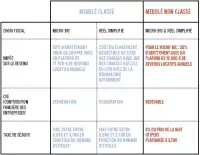
The default tax regime is the Micro-Enterprise Regime for Non-Professional Industrial and Commercial Profits. (Annual revenue must be less than €15,000 for unclassified furnished rentals or €77,700 for classified furnished rentals.)
The owner simply needs to report their gross income on lines 5ND (for unclassified furnished rental properties) or 5NG (for classified furnished rental properties) of Form 2042 C PRO (for self-employed individuals), under the section “Income from non-professional furnished rentals, Micro-BIC regime”
This gross income will be subject to a 30% or 50% deduction. The 50% deduction is granted only to tourist rental properties, i.e., classified furnished rentals. Please note that for just €72, the Maison des Propriétaires is authorized to conduct inspection visits for tourist rental property classification. Contact us.
IMPORTANT: If your furnished rental is classified, be sure to check your tax return to ensure you have filled out box 5NG (and not 5ND); otherwise, you will only receive the 30% deduction!
Once the deduction has been applied, the remaining profit is added to your other income and will be taxed at the average rate for your tax bracket.
The landlord is required to keep a simple record of expenses and income, which may be requested at any time.
B/ The Simplified Actual Income Tax Regime
It is possible to opt for another tax regime: the Simplified Actual Income Tax Regime for Non-Professional Industrial and Commercial Profits.
This option requires keeping accounting records, including the preparation of an income statement and a balance sheet (Form 2031 and its Schedule 2033).
This option allows you to deduct actual expenses incurred, as well as to expense loan interest and depreciation (on the value of the property, work performed, equipment, furniture, etc.). This option is recommended in the case of renovations.
Given the value of the real estate relative to the rent collected, this often results in a deficit, meaning no taxes are owed on this income.
This tax strategy may seem burdensome due to administrative requirements, but it can result in significant tax savings. We recommend consulting a professional tax advisor.
SOCIAL SECURITY CONTRIBUTIONS
These profits, after allowances or deductions for actual expenses, are also subject to social security contributions (currently 17.2%).
LOCAL TAXES
- Property tax as the owner of the property
- The housing tax is payable by individuals who have access to a second home in the municipality
- The Business Property Tax (CFE) is payable by owners who rent out furnished properties. This is a local tax that is not tied to income.
Pursuant to Article 1478 of the General Tax Code, the Business Property Tax is assessed based on the situation as of January 1 of the tax year.
⚠️ If you are a non-professional landlord of furnished properties, you can view your CFE notice in your tax portal. This notice is no longer sent by mail.
Yes, you are liable for this tax; the business tax has been replaced by the Territorial Economic Contribution (CET). This new contribution has been in effect since 2010. It consists of two components: the Corporate Property Tax (CFE) and the Corporate Value-Added Contribution (CVAE). Rental or sublease activities (with the exception of the rental of unfurnished residential housing) are considered to be carried out on a commercial basis. Article 1447 of the General Tax Code further provides that this contribution applies to both individuals and legal entities, as well as unincorporated businesses. You must therefore pay it within 30 days of the assessment (Art. 1663, paragraph 1 of the General Tax Code).
Exemption from the CFE is granted for classified furnished rental properties.
To have your property classified, contact us at maisondesproprietaires@lesarcs.com. NOTE
: The situation as of January 1 of the tax year is what counts.
A classification issued after January 1, 2024, will take effect for the 2025 CFE.
A classification issued on December 31, 2024, will take effect for the 2025 CFE.
- Household Waste Tax
- Tourist tax: Since your tenants pay this tax to you, it is not your responsibility, but you are required to collect it and remit it. For this tax, which contributes to the resort’s economic development, you act solely as a collector. It’s a “win-win” principle designed to sustain the virtuous cycle of high-quality tourism.
SACEM ROYALTIES