This summer, introduce the whole family to mountain hiking with our practical tips: trip lengths tailored to age, backpack weight, safety tips… everything you need to get kids excited about hiking without wearing them out.

Hiking with Young Children: A Guide
This summer, it’s decided: you’re taking the whole family to the mountains to introduce them to the joys of hiking. But by the way, do you know how long your youngest can hike? And how much weight your oldest can carry without hurting their back? Follow our guide for a smooth introduction… that will make them want to follow in your footsteps!
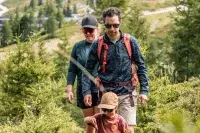
Step 1: Stack the odds in our favor
Hiking? It’s easy! Well… unless: your shoes are hurting your feet; or your socks are slipping and bunching up; or the tag on your T-shirt is itching you; or you’re too hot, or too cold; or your backpack is too heavy; or the sun is blinding you; or… You get the idea!
So before you set off, make sure everything’s in order. That your little ones’ feet haven’t grown a size between the time you bought their hiking shoes and the time they break them in. That their backpack doesn’t weigh more than 10% of their body weight (snack and stuffed animal included). That you’ve packed water, sunscreen, sunglasses, a hat, and a windbreaker in your own bag for each budding adventurer (along with a box of Paw Patrol band-aids; they might just save the day).
In short: do everything you can to make sure everyone feels physically ready before hitting the trails. If in doubt, give that shoe your child is reluctant to put on one last shake; you’re sure to find a little pebble lurking inside…
Step 2: Manage fatigue before/during the hike
A few things to keep in mind to get started:
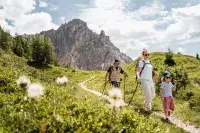
- Before age 3, forget about “real” hiking—it’s too strenuous for little legs that are still unsteady. Instead, opt for natural sites that are easily accessible with a stroller or baby carrier, and let them toddle around and play as they please. Or take a gondola to enjoy a picnic with a view from the panoramic terraces overlooking the resort (effortlessly).
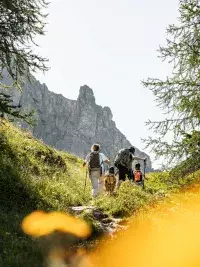
- Ages 4 to 7: choose a short route with little elevation gain. The FFR (French Hiking Federation) offers an easy-to-remember guideline: no more than 1 to 2 km of walking per hour.
- Ages 8 to 12: distances can start to get longer, especially if your child is used to walking. Be careful, however, not to overlook the elevation gain! A 10-km hike with 500 m of elevation gain (D+) will be much more strenuous than a 10-km hike on flat ground*
.- Ages 12 and up: teens can “more or less” keep up with adults. Provided you let them sleep and eat as much as their growing bodies demand (and you manage to convince them to go for a walk with their dear old folks…).
Now that you have a slightly better idea of how far the youngest member of your family can go, all you have to do is pick your next family hike from the thirty or so routes detailed here: https://www.lesarcs.com/balades-randonnees (our favorites include La Voie Verte along the Isère River in Bourg-Saint-Maurice, Le Chemin des Espagnoles between Arc 1600 and Arc 1800, and La Chapelle Notre-Dame des Vernettes for older kids).
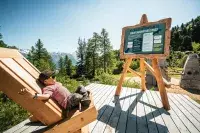
And of course, don’t forget to take regular breaks! To rest, keep an eye out for marmots, have a snack (or two, or three), reapply sunscreen, take a sip from your water bottle (and lighten the load while you’re at it), admire a flower, or watch a funny insect… After all, you’re on vacation, aren’t you?
*If you’re into numbers, you can have fun talking in “kilometer-effort,” a unit that takes into account both distance and elevation gain. The calculation is simple: add 1 km for every 100 m of elevation gain. Example: a 10 km hike with 500 m of elevation gain = 10 km + 5 km = 15 effort-kilometers. Right away, you realize that’s a lot for little ones…
Step 3: Do everything we can to keep boredom at bay
Hiking? At first, it was fun. A pretty rock, a marmot darting across the trail right in front of you, a little stream to cross… Every step promised a wild adventure! And then, after 500 meters, they got sick of the rocks, the marmots whistling “where is she?? Why can’t I see her??”, the streams you can’t even dip your feet in—it’s not fair…
That’s where our secret weapon comes in: carrots! Not the kind that make you nice (though…): the kind that get you moving, because there’s fun to be had. Three tried-and-true ideas:
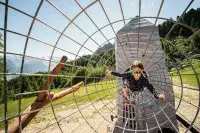
- The Arollins Trail, in the Malgovert Forest: a lovely 45-minute walk (105 m elevation gain) during which you’ll discover adorable wooden gnomes, hidden among the trees, bushes, and rocks. At the end of the trail: three playful wooden structures, the Giants of Malgovert, to climb on.
- The Homme-Cairn Trail (NEW IN 2025): a walk that will delight curious and imaginative children, featuring legendary carved figures and fun workshops (building a cairn—a sort of stone pyramid, hopping from rock to rock along a stepping-stone path, reconstructing a stone arch…).
- The Lakes Trail or the Arc Valley Lake Loop, starting from Arc 2000: these two hikes begin and end not far from the Varet gondola. But what’s at the top of the Varet gondola? The Luminous Murals of the Aiguille Rouge, hidden in the ski lift garage! Promise your kids you’ll stop by after your hike, and you might have a hard time keeping up with them on the trails…