Planning a trip to the mountains this summer? Let’s go over a few tips to help you blend into the landscape like a chamois on a scree slope! A 100% useful quiz (to be taken with a grain of salt).
Swimming in a mountain lake is…
- Refreshing (it even tingles a little!)
- Invigorating (free cryotherapy!)
- Criminal (already using big words…)
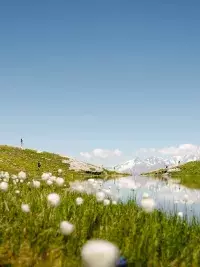
Swimming in a mountain lake is indeed criminal for all the tiny plants and creatures that live there or come to drink from it. Mountain lakes are fragile ecosystems that must be protected at all costs from outside contaminants (even invisible ones). After all, would you like it if someone put sunscreen and microplastics in your glass? Neither would the ibex, the fish, nor the aquatic plants.
So resist the urge, prove you’re human, and curb your desire to take a dip (even if it’s just your feet or hands). Pack plenty of water in your hiking backpack to cool off, a cap or a wide-brimmed hat, and plan a quick trip to the pool when you get back—and the heat won’t get the best of you. Promise!
Pitching your tent for the night in a charming little valley is…
- Great for impressing your Instagram community
- Great for risking a fine
- Great for getting a good night’s sleep
This one’s a bit technical. Because the rules for camping in France are complex, to say the least. To put it simply: you’re allowed to pitch your tent anywhere—except where it’s prohibited. Except that there are plenty of places where it’s prohibited. Private property (and it’s not always easy to tell if a piece of land is private or not), parks and nature reserves, protected or designated sites, and areas near water sources used for water collection, etc.
The good news is that it’s perfectly possible to camp in the Vanoise National Park, but only in the immediate vicinity of the mountain refuges (you’ll just need to pay a small fee to the caretaker upon arrival). You’ll need to set up your tent (lightweight and compact) after 7 p.m. and take it down before 8 a.m. It goes without saying, but it’s obviously forbidden to build a fire… Practical info: You’ll have access to restroom facilities, and you can even have dinner with other backpacking hikers if you opt for half-board. But this is just between us—we won’t tell your fellow adventurers, so sleep soundly…

Picking mountain flowers to press between the pages of your favorite novel is…
- So romantic.
- So 1965. Flower power and all that jazz.
- Such a bad idea. Because if everyone does the same thing, there won’t be any flowers left for the bees to pollinate.
Picking mountain flowers? Please don't! In the Vanoise National Park, it’s even strictly prohibited. So yeah, it’s tempting. It would make a pretty bouquet. It’d be handy for looking up the name of that flower—“Man, this is crazy, it’s right on the tip of my tongue!” But the bouquet would just end up wilting anyway. And besides, you can always take a photo of the flower and use Google Lens to identify it as soon as you have a signal—if it’s really bugging you.
And for those of you who might be tempted to pick génépi to bottle it: be aware that picking génépi (black génépi, white génépi, and glacier génépi) is strictly regulated. To be clear: it’s prohibited in the Vanoise National Park, and limited to 120 sprigs per day per person in the Savoie department (excluding protected areas). Of course, you still need to know the spots… But shhh!
Everything you need to know about foraging in Savoie: (blueberries, gentians, mushrooms, edelweiss…)
Everything you need to know about the flora of the Vanoise National Park
Following the marked trails without cutting corners means…
- A herd mentality thing. Baa!
- A weakling’s move. When you’ve got strong thighs, you climb “straight up the slope.”
- A visionary’s thing. Staying on the trails means protecting everything around them, so we can enjoy them for as long as possible.
Sticking to the trails is anything but overrated! When you look at “adventure” content creators, you get the impression that you absolutely have to go off-trail in remote natural areas to be a real man (or a real woman—you get the idea). Except that, in reality, straying off the trails is disrespectful to the very nature you originally wanted to reconnect with.
So even if it would be faster to cut a few corners; even if you come across hikers who aren’t moving fast enough for your liking; even if there’s a cow right in the middle of your path: stay on the trails. Now, as for the cow, you’re allowed to go around it without waiting for it to move on to graze elsewhere. Special permission granted. In all other cases, it’s a firm “no.”
By keeping your footsteps to the trails, you’re protecting the flora and minimizing the risk of erosion. Mother Nature thanks you (and so will your great-grandchildren!).
Sharing your picnic with the local marmots is…
- Truly animal-friendly
- Really upsetting for the person who made your sandwich
- Really not cool for your friends, who were eyeing it hopefully
Watch out, trap! Actually, you can’t use the word “philanthropic” when talking about animals. Only humans. But never mind that: just remember not to feed any wild animals you come across on your walks. Not even those cute little marmots, under the pretext that they need to stock up before winter.
And if your sandwich is REALLY not that great (or if you want to ruin a friendship by not sharing the leftovers you can’t finish): pack it in your hiking backpack and take it home. Don’t leave it by the side of the trail “just in case a hungry chamois comes along.” It’s the same with any papers, wrappers, tissues… Anything that came with you comes back home with you.
So, what’s the verdict? How many out of 5 did you get right? Do you know the rules? If so, let’s meet on the trails this summer!