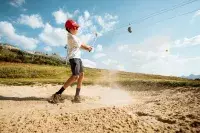
Le Golf des Arcs is open from June 15 to September 27, 2026. Learn more about its eco-friendly practices.

Eco-friendly practices at the heart of the journey
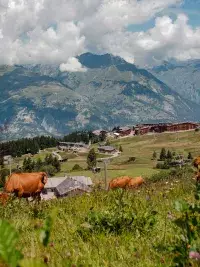
Les Arcs Golf offers a unique mountain experience with panoramic views of the surrounding peaks and the Upper Tarentaise Valley. Considered one of the most beautiful mountain courses in France, we couldn’t agree more!
Just like the resort’s architecture, the Golf des Arcs is designed to blend seamlessly into the Alpine landscape by working with the natural features of the terrain. Measures have also been in place for over 20 years to protect this magnificent course. Come on, let’s find out more about the practice greens at the Golf des Arcs.

Swinging toward a more virtuous playing field
For the past 20 years, golf courses have been turning their backs on chemicals with a zero-pesticide approach. Not a trace of herbicides, fungicides, or insecticides. And guess what? All the products used come from organic farming.
Goodbye diesel, hello GTL for the mowers! This fuel is derived from natural gas, with virtually no sulfur, minimal emissions, not a hint of toxicity, excellent natural decomposition, and as a bonus, a much more pleasant purr for everyone’s ears!
Water is a precious resource, which is why Les Arcs Golf Club strives to conserve it. The water used to irrigate the course comes from the snow cannons, not from our drinking water supply. Only the greens and tees are watered—barely 2.5% of the course’s total area. The fairways, meanwhile, follow nature’s rhythm: basking in the sun’s rays and getting a little green boost when the rain returns. Watering begins at dawn, at 5 a.m., to prevent any risk of evaporation.
The areas between the fairways are left to grow wild, a measure designed to protect local wildlife and preserve that precious bit of moisture. As you walk the course, you’ll also discover two wetlands. Mowing is done only once a year to preserve the natural balance, and the timing is carefully chosen so as not to disturb the flora and fauna.
This commitment to the planet is also reflected in waste management. Each season begins with a major cleanup to remove any traces left by skiers. And as a finishing touch, seasonal equipment (tee markers, stakes, ropes, trash cans, nets, etc.) appears in June and disappears without a trace as September approaches, leaving the landscape untouched.
Les Arcs Golf is much more than just a course—it is committed to minimizing its impact on nature!



The Golfer's 5 "Green" Practices:
Here are five tips to help you enjoy this sport in style while taking care of the natural environment around you:
Zero Waste, Perfect Swing: Imagine a course with not a single piece of trash in sight. By choosing a reusable water bottle, you’re making a big difference in reducing plastic waste. And don’t forget—your trash should never end up on the golf course.
Carpooling and Sharing: Among teammates, opt for carpooling or public transportation to get to the course. Who knows, your conversations during the ride might just set the stage for future birdies!
Harmony with nature: Embrace every dandelion and every blade of grass glistening in the sun! After all, diversity makes every round unique, just like the courses you play.
A Second Life for Your Gear: Your equipment may have seen a few seasons, but it can still shine brightly. Consider giving your old clubs a second life by selling, lending, or donating them… Who knows, it’s sure to make someone happy!
Respect for protected areas: On the golf course, strictly observe the areas designated by the course. Behind these protected areas lies a living ecosystem.
Golf terminology to help you better understand the article:
Green: The "green" refers to the well-manicured, grassy area around the golf hole where the flag is placed. It is the surface that golfers aim for to roll their ball and finish the hole.
Fairways: "Fairways" are the grassy areas between the tees and the greens on the golf course.
Par: "Par" is the standard number of strokes a golfer is expected to take to complete a given hole. Thus, a par-3 hole means it is expected to be completed in three strokes, a par-4 in four strokes, and so on.
Birdie: A "birdie" is a term used when a golfer completes a hole with one stroke fewer than the par set for that hole. For example, if the par for a hole is 4 strokes, and the golfer manages to complete the hole in 3 strokes, they achieve a birdie.
Swing: The "swing" is the motion a golfer makes to hit the ball.