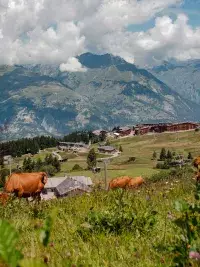
Why not use your holiday in Les Arcs as an opportunity to adopt more eco-friendly habits? Reducing your carbon footprint is easier than you think.

9 Ways to Reduce Your Carbon Footprint
Want to take your commitment to the environment to the next level in 2027? Why not rethink your holiday habits to complement the eco-friendly actions you’re already doing so well in your daily life!
A food change here, skipping a purchase there… Since the hardest part is often knowing where to start, we’ve selected 9 “green resolution” ideas for you (ranging from easy to expert level) that reduce the carbon footprint of your ski holiday… a little, a lot, or even drastically!
So? Which resolutions will you try to stick to this year? Let’s meet up on December 31st to take stock (not forgetting to reminisce about every moment).
To reduce your carbon footprint "a little"
Start by changing some habits! A little less meat, a little more vegetables, locally sourced products: that’s all it takes to reduce the CO2 emissions from your diet while on holiday (on average: 8% of the total carbon footprint of a day of skiing / the third-largest source of emissions after transportation and equipment).
1. Easy level: celebrate with local beer
Save your thirst for Belgian beers for your next trip to Brussels! During your stay in Les Arcs, opt for a local beer during après-ski: the “Retour d’est” IPA from the Les Névés microbrewery, for example, or the “Free Rider” session pilsner from the Brasserie du Petit Saint Bernard (to name just two; alcohol abuse is dangerous to your health; please drink responsibly, as always!).
2. Advanced level: skip the Camembert on the cheese platter
Not easy, it’s true. Especially if you’re from Normandy. Hang in there! You’ll be able to indulge in your guilty pleasure again in a few days, when you’re back “home.” In the meantime, treat your refined palate to a few local specialties: a Beaufort AOP with hints of hazelnut made in Bourg-Saint-Maurice, for example, or a goat’s milk tommette straight from the Rullier farm.
3. Expert Level: Eat a porcini mushroom fondue instead of raclette
We KNOW you’re going on a ski holiday largely for the mountain of cheese you’ll be able to “polish off” over the course of the week. But rather than eating raclette after raclette, opt for a porcini mushroom fondue every now and then (without the charcuterie topping). A deliciously painless effort, we promise!



To significantly reduce your carbon footprint
Rethink how you gear up for the slopes. Where and how are your skis made? Your boots? Your Gore-Tex jacket? Your socks? By choosing more sustainable products, you could significantly reduce the CO2 emissions caused by your gear (on average: 16% of the total carbon footprint of a day of skiing / the second-largest source of emissions after transportation and before food).
1. Easy level: buy new, but choose eco-friendly brands
In some cases, buying new is still a good idea. For example, if you take good care of your gear and know how to make it last; or if you use your equipment very frequently (it’s cheaper to buy than to rent). In that case, opt for eco-friendly brands committed to developing sustainable products (such as Picture, for example).
2. Intermediate Level: Buy your snow sports gear secondhand
Skis, snowboards, jackets, pants, technical underwear… You can find everything on the secondhand market! Look for items in good or very good condition, ideally from eco-friendly brands, and you’ll be able to pack them in your suitcase for many years to come. Perfect if you ski once or twice a year, or if you want to invest in quality gear without the means to buy new.
3. Expert level: rent your winter sports gear (skis, clothing…)
Here, you’re tackling the root of the problem: a product that isn’t bought is a product that doesn’t need to be made! By renting your skis, snowboard, or even your ski outfit, you’re helping to conserve the resources needed to make them. Perfect if you ski once or twice a year (the planet and your wallet will thank you).
Can’t decide whether to rent or buy your ski gear? We’ll help you choose the solution that best fits your needs.
To slash your carbon footprint “drastically”
Make the journey to your holiday destination more eco-friendly. After all, the clear “champion” in carbon emissions is transportation: on its own, it accounts for 52% of the carbon footprint of a day on the slopes! To drastically reduce your carbon footprint, you’ll need to address what happens long before you strap on your skis—and well after you return them to the rental shop.
1. Easy Level: Go for a Long Trip Instead of Many Short Ones
Do you usually go away for 20 days a year? Fight your tendency to be restless: rather than booking five short trips of four days each (and spending half the time on the road, let’s be honest), really settle in for two 10-day stays, or even one 20-day stay in the same place. Take your time, explore, relax, try out activities, and treat yourself—both literally and figuratively. And save money while you’re at it (gas and tolls add up…).
2. Intermediate Level: Play at Setting Geographical Limits
We trust you to set the rules: never travel more than 1,000 km from home? Travel less than 100 km at least half the time? Travel only to tourist destinations accessible by train, with no distance limit? It’s up to you!
3. Expert Level: Choose the mode of transportation with the best balance of convenience and eco-friendliness
Depending on where you live and who you’re traveling with, this could be: the train (and other public transit options like the bus, coach…), the car (packed full, with your whole family or carpool partners), the bike (let’s go wild!)…
Is taking the train for a ski vacation complicated? We’ll help you get on track!
Good to know: The 4th place for carbon emissions during a ski trip goes to… accommodation!
That’s right: tourist accommodations account for 4% of the carbon footprint of a day of skiing (the fourth-largest source of carbon emissions on average, after transportation, equipment, and food).
Hence the importance of choosing a recently built or renovated, well-insulated accommodation. And of keeping the temperature around 19°C during your stay (no sauna effect or cryotherapy: don’t overuse the heat, and be sure to close the windows after airing out the room). Obviously, turn off the lights when you head out to ski (this isn’t Versailles!), sort your trash, and don’t take endless showers… In short: do exactly what you would at home. Easy!

Now it's your turn!
Calculate your carbon footprint (and compare your result to the average carbon footprint of a day of skiing). So, are you doing better or worse?